
How to Write a Resume for Winning Success in 2026: The Perfect Guide
The New Reality of Job Hunting in 2026
The North American job market in 2026 has undergone a seismic shift. We have moved past simple keyword matching into the era of Agentic Recruitment. Today, your resume isn’t just being “scanned” by a computer; it is being “interviewed” by highly sophisticated AI agents before a human recruiter even sees your name.
If you want to know how to write a resume that actually lands interviews in this environment, you must understand that the old rules of 2022 no longer apply. You need a document that is semantically rich, data-heavy, and structured for both machine intelligence and human decision-makers. This guide provides the exact blueprint for success in the 2026 hiring landscape.
The 2026 Engine: Understanding Agentic ATS & NLP
To learn how to write a good resume today, you must first understand the technology on the other side of the “Apply” button. In 2026, most North American companies use Natural Language Processing (NLP) and Large Language Models (LLMs) to evaluate candidates.
The Shift to Semantic Entity Extraction
Modern Applicant Tracking Systems (ATS) no longer look for isolated words like “Python” or “Project Management.” Instead, they perform Semantic Entity Extraction. They build a “Knowledge Graph” of your career. If a job description requires “Cloud Scalability,” the AI looks for clusters of evidence: latency reduction, microservices architecture, AWS/Azure deployment, and load balancing.
Intent Matching
The AI also analyzes your “Intent.” It looks at the verbs you choose to determine your seniority level. A candidate who “Assisted in…” is categorized as junior, while one who “Architected…” or “Spearheaded…” is tagged as a high-level lead. To pass this scan, your resume must demonstrate a high Semantic Density—meaning every sentence must provide context-rich information that proves you understand the industry’s underlying logic.
Preparation: Choosing the Right 2026 Format
In 2026, “clean and functional” beats “creative and cluttered.” North American recruiters and AI agents both prefer a structure that allows for rapid data extraction.
The Three Standard Formats
- Reverse-Chronological: The gold standard for 90% of applicants. It highlights your most recent (and relevant) growth.
- Hybrid (Combination): Best for senior professionals. It places a “Core Competencies” matrix at the top, followed by a chronological history.
- Functional: Only used for extreme career pivots. (Note: Most 2026 AI agents find this format suspicious, use with caution).
Formatting Commandments
- Columns: Always use a single-column layout. Multi-column resumes often cause “parsing drift,” where the AI reads across the page instead of down.
- Fonts: Use system-agnostic sans-serif fonts like Inter, Lato, or Calibri. Avoid progress bars or skill-level dots; they are unreadable to modern NLP engines.
- The Top Third: This is your “Prime Real Estate.” Your most important metric must appear in the top 1/3 of the first page.
The Header: Your Professional Digital Identity
In 2026, your contact information is your “Proof of Work” gateway.
- Name: Clear and bold.
- Professional Title: Match the specific job you are applying for. If the JD says “Customer Success Lead,” and you were a “Client Relationship Manager,” adjust your title to the target role.
- Location: “City, State” is enough. Full addresses are a privacy risk.
- LinkedIn & Portfolio: These are mandatory. North American recruiters now expect a link to a GitHub, a personal site, or a LinkedIn profile that mirrors the resume’s data.
Pro Tip: Never include a photo on a North American resume. Anti-discrimination laws make recruiters instantly discard resumes with photos to avoid legal bias.
🚀 Stop Struggling with “Impact”
Don’t just list duties. Log in and use our AI to instantly transform your past experiences into high-performing STAR 2.0 metrics.
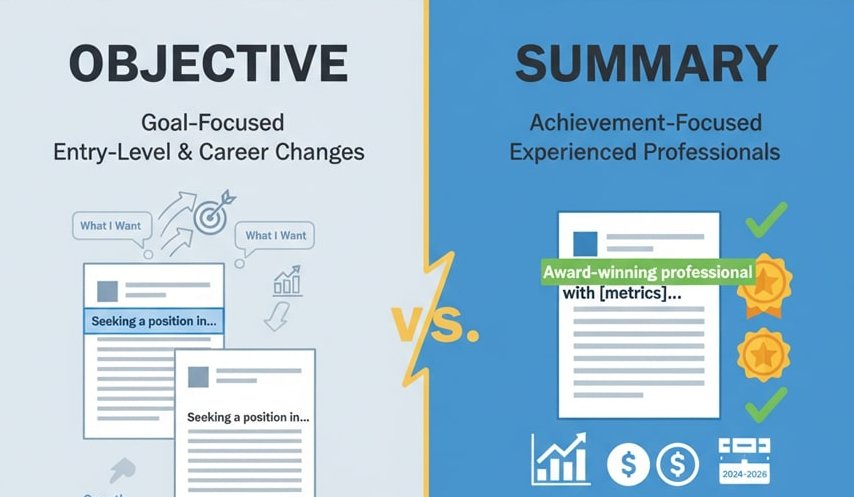
The Hook: Summary vs. Objective
This is where you set the tone. Most applicants fail here by being too vague.
How to Write a Resume Summary (For Experienced Pros)
A 2026 summary is a “Value Proposition.” It should be 3-4 lines long and packed with data.
- Weak: “Experienced Marketing Manager with a passion for helping brands grow through social media.”
- Strong: “Growth-focused Marketing Lead with 8+ years of experience in SaaS. Scaled annual recurring revenue (ARR) from $2M to $15M in 24 months. Expert in reducing Customer Acquisition Cost (CAC) by 30% through AI-driven lead scoring workflows.”
How to Write an Objective for a Resume (For Students/Career Changers)
Only use an objective if you are learning how to write a resume with no experience. Focus on your skills and how you will solve the employer’s problems.
- Example: “Data Science graduate with expertise in Python and predictive modeling. Seeking to leverage internship experience at XYZ Tech to optimize supply chain efficiency for [Company Name].”
Professional Experience: The STAR 2.0 Method
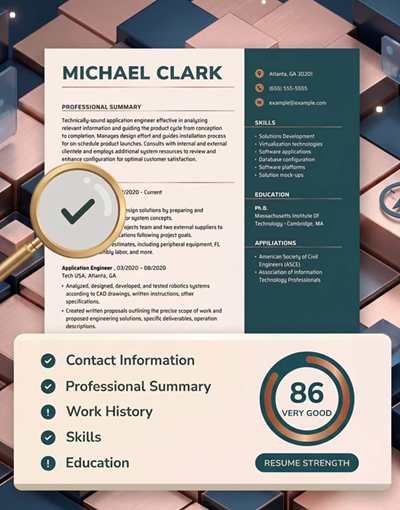
This is the core of how to write a great resume. In 2026, we use STAR 2.0 (Situation, Task, Action, Result, and Impact). You must move from listing duties to proving transformations. The Harvard Business Review emphasizes that “quantifiable impact” is the #1 trait high-performing candidates share.
Industry-Specific “Right vs. Wrong” Examples
Technology (Software Engineering / Data)
- ❌ Wrong: “Responsible for maintaining the company’s cloud infrastructure and fixing bugs.”
- ✅ Right (2026 Standard): “Architected a self-healing microservices environment using Kubernetes and AWS, reducing system downtime by 38% and saving the engineering team 15+ manual hours per week through CI/CD automation.”
Marketing & Sales
- ❌ Wrong: “Helped manage social media campaigns and tracked engagement metrics.”
- ✅ Right (2026 Standard): “Engineered a full-funnel lead generation strategy that lowered Customer Acquisition Cost (CAC) by 22% while increasing MQL-to-SQL conversion rates by 15% through AI-driven personalization and A/B testing.”
Finance & Operations
- ❌ Wrong: “Managed monthly financial reports and assisted with annual audits.”
- ✅ Right (2026 Standard): “Streamlined the month-end closing process by integrating automated reconciliation tools, reducing reporting cycles from 7 days to 3, and identifying $120k in annual cost-savings through variance analysis.”
How to Write a Resume with No Experience
Entering the workforce in 2026 without a traditional job history is a challenge, but you can win by focusing on Project-Based Evidence.
When learning how to write a good resume without work experience, prioritize these sections:
- Technical Projects: Describe your senior capstone or GitHub projects as if they were jobs. Use the STAR method.
- AI Fluency: In 2026, every entry-level role requires AI competency. List your experience with LLMs, prompt engineering, or workflow automation tools.
- Relevant Coursework: Only list high-level or specialized courses that match the job description.
- Volunteer Leadership: Managing a student club or a non-profit’s social media is “Proof of Work.”
The Skills Matrix: The 2026 Trinity
Your skills section must be split into three distinct categories to satisfy both AI agents and human HR managers.
- Hard Skills: Quantifiable tools (e.g., SQL, Python, Salesforce, Financial Modeling).
- Soft Skills: High-value human traits (e.g., Cross-functional Leadership, Strategic Negotiation, Emotional Intelligence).
- Hybrid/AI Skills: Your ability to work with technology (e.g., AI Workflow Automation, Prompt Engineering, Data Ethics).
Technical Optimization: Passing the “Agentic Search”
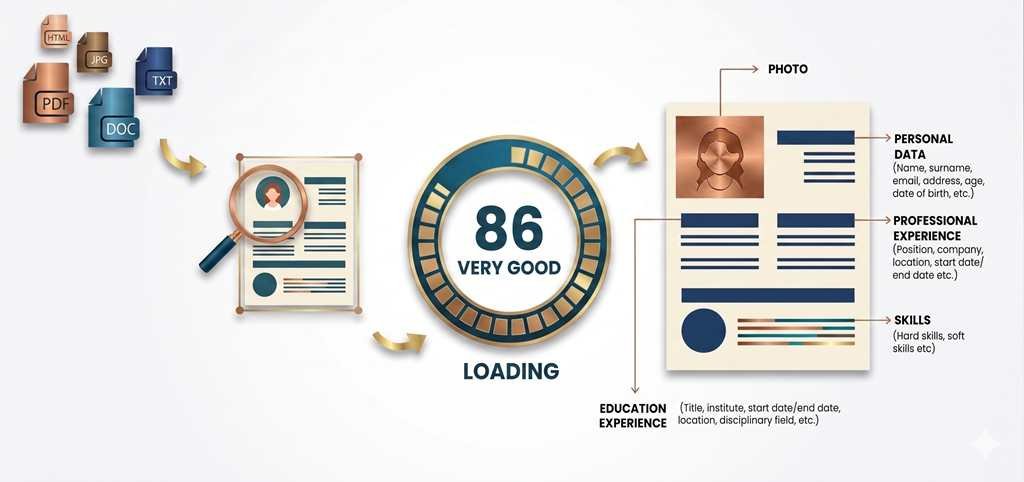
In 2026, your resume must be technically flawless. If the “parsing” fails, you don’t exist in the database.
- No Images inside the main text: AI agents often fail to read text embedded in images.
- Standard Headers: Use standard titles like “Work Experience” and “Education.” Don’t get creative with titles like “My Journey” or “Places I’ve Been.”
- Keywords vs. Context: While you need the right keywords, the AI now checks for Co-occurrence. If you list “SEO” as a skill but never mention it in your experience, the AI will lower your ranking.
The Ultimate 20-Point Resume Checklist (2026 Edition)
Before you hit “Apply,” run your document through this checklist. This table is designed for 2026 North American standards and can be directly copied into WordPress.
| Category | Requirement Checkpoint | 2026 Success Criteria |
| Content | Quantified Wins | Does every bullet point contain at least one %, $, or #? |
| Power Verbs | Does every bullet start with an active verb (e.g., Spearheaded)? | |
| No “Fluff” Zones | Have you removed cliches like “Team player” or “Hard worker”? | |
| Semantic Density | Does each bullet add new context instead of repeating tasks? | |
| SEO/AI | NLP Optimization | Have you included 5-7 keywords from the Job Description? |
| AI Collaboration | Did you list specific AI tools or workflows used in your role? | |
| Intent Matching | Do your verbs reflect the seniority level of the target job? | |
| Layout | The 5-Second Test | Can a recruiter find your top win in 5 seconds? |
| Single Column | Is the layout a standard single-column format? | |
| White Space | Is there enough white space to prevent “text-heavy” fatigue? | |
| Technical | File Architecture | Is it a PDF with UTF-8 character encoding? |
| Links | Are your LinkedIn and Portfolio links live and clickable? | |
| Name Format | Is your file named “[FirstName]-[LastName]-Resume.pdf”? | |
| Grammar Scan | Have you run a 2026-level AI spell check? | |
| Strategy | Title Match | Does your resume title match the Job Description exactly? |
| Summary | Does your summary include your biggest career win? | |
| US/Canada Standard | Have you ensured NO photo and NO birthdate are included? | |
| Gap Management | Are career gaps explained as “Professional Development”? | |
| Contact Validity | Is your email address professional and name-based? | |
| CTA Readiness | Is your resume ready for an Agentic scan by CVobjective’s ATS Checker |
Advanced FAQ: Solving 2026’s Toughest Resume Problems
Q1: How to write a resume if my industry is being disrupted by AI?
Position yourself as an “AI-Augmented Professional.” Show how you use AI tools to increase your output. Instead of just listing “Coding,” list “AI-assisted development with GitHub Copilot.” This proves you are future-proof.
Q2: Should I use a “Skills” section or a “Core Competencies” matrix?
Use both. A “Core Competencies” matrix at the top helps the AI index your keywords instantly, while the “Experience” section provides the evidence.
Q3: Is it okay to have a 2-page resume in 2026?
Yes, if you have 7+ years of experience. In North America, the first page is for selling, and the second page is for supporting data. If the first page doesn’t grab them, the second page won’t matter.
Q4: How to write a resume summary that doesn’t sound like a robot wrote it?
Avoid the “professional seeking a role” template. Use a “Value Proposition” statement. Speak directly to the company’s pain points. (e.g., “Solving scalability issues for Series B startups…”)
Q5: How do I pass the “Agentic Search” if I have a non-traditional career path?
Focus on “Functional Equivalency.” Use your resume to translate your past experiences into the vocabulary of your target role. CVobjective.com specializes in this “Semantic Mapping.”
Q6: What is the most common mistake when learning how to write a resume today?
Over-designing. Many candidates use Canva-style templates with graphics. These are “ATS Poison.” They often fail to parse, leading to a “Null” profile in the database. Stick to a clean, text-based structure.
Conclusion: Why CVobjective.com is Your Secret Weapon
Knowing how to write a resume in 2026 is no longer about following a fixed template; it’s about dynamic, AI-driven optimization. You are competing against thousands of applicants, many of whom are using AI to gain an advantage.
At CVobjective.com, we give you that advantage. Our platform is built on the latest 2026 North American hiring algorithms.
- Real-Time AI Scoring: See exactly how you rank against a Job Description.
- NLP Keyword Injection: Automatically identify and fix “Semantic Gaps.”
- Agent-Ready Templates: Designs that pass every ATS filter with a 99.9% success rate.
✨ Ready to Land Your Dream Job?
Join thousands of job seekers who bypassed AI filters and landed interviews at top firms using CVobjective.



0 Comments