What to Bring to an Interview: 12 Essentials + Complete Checklist
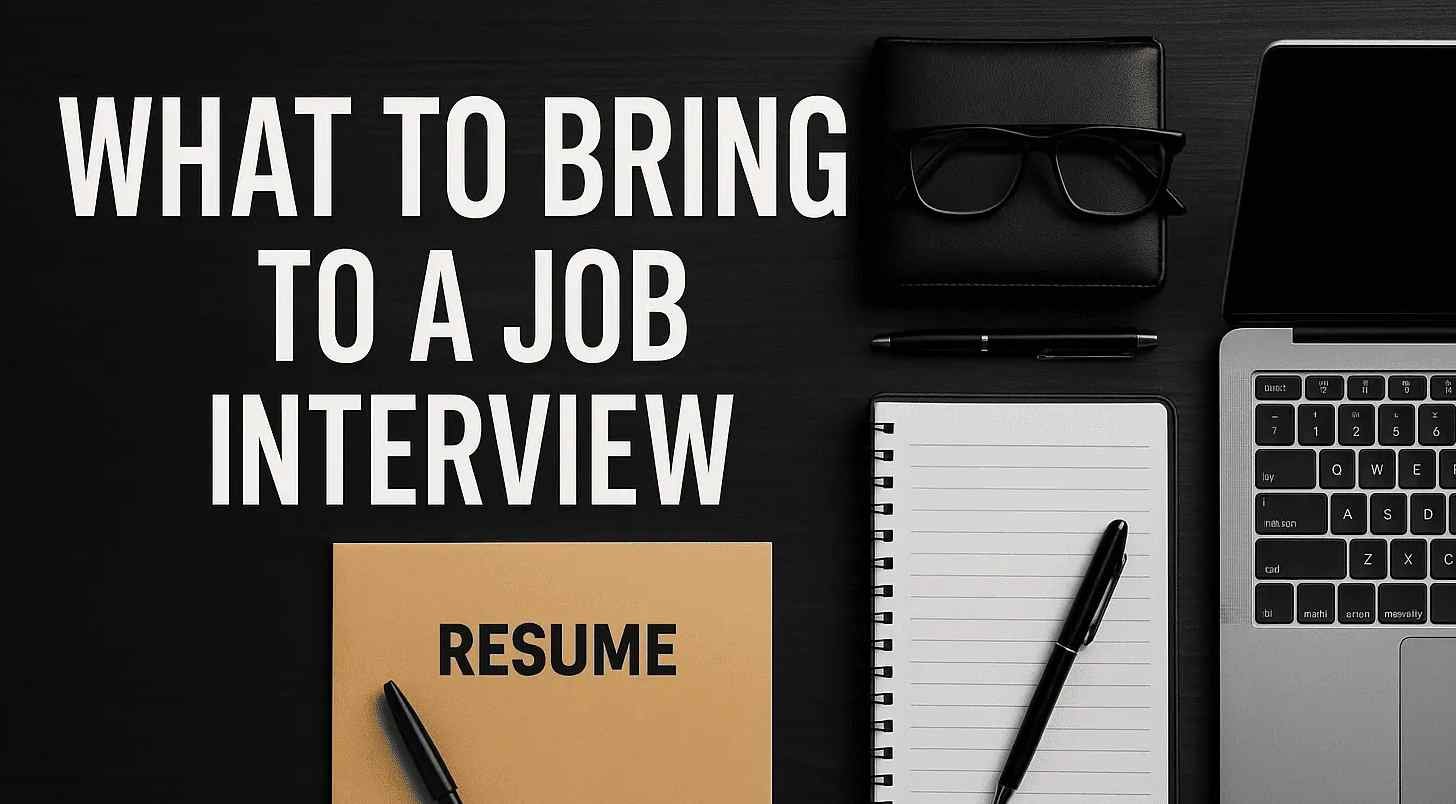
Elevating Your Presence: Why the Interview Toolkit Matters
Knowing what to bring to an interview can remove one unnecessary source of stress on interview day.
You do not need an expensive leather portfolio, luxury pen, or a bag full of documents. You simply need the materials that help you stay organized, answer questions clearly, and handle common situations without scrambling.
For most in-person interviews, a useful starting list is:
- copies of your resume;
- a pen;
- a notebook or notepad;
- your prepared questions;
- identification if the building or employer requires it;
- a portfolio or work samples if relevant;
- any documents the employer specifically requested.
Harvard’s Mignone Center for Career Success recommends bringing extra resume copies, pen and paper or a padfolio, and writing samples or a portfolio when appropriate for the role.
Harvard Career Services – Interviewing
Indeed similarly recommends resume copies, pen and paper, and pre-written questions for interviewers.
The key principle is:
Bring what helps you participate in the interview—not everything you own.
Beyond the Basics: Why Your Interview Toolkit Drives Success
Being prepared does not guarantee you the job, but it prevents avoidable problems.
You may discover that:
- another interviewer joins unexpectedly;
- the hiring manager does not have your resume open;
- building security asks for ID;
- Wi-Fi fails when you want to show a portfolio;
- you forget the questions you planned to ask;
- you want to write down an important detail about the role.
Having a few simple materials ready makes these situations easier.
Indeed notes that extra resume copies can be useful when additional professionals join the interview or when the interviewer wants a physical copy.
Preparation should support the conversation rather than become part of the performance.
You do not need to impress someone with the brand of your notebook.
You need to be able to find what you need quickly.
Essential Physical Items for Every Professional Meeting
If you are wondering what to bring to an interview, start with these essentials.
1. Copies of Your Resume
Bring several clean copies of the same resume version you submitted for the job.
Indeed recommends bringing multiple copies, while Harvard also recommends extra resume copies for an in-person interview.
A practical amount is:
one copy for each expected interviewer, plus one or two extras
You do not need premium paper. Standard clean white resume paper is fine.
2. Pen and Notebook
Bring a simple pen and notebook.
You can use them to record:
- names;
- next steps;
- important details about the role;
- questions that come up during the interview.
Indeed notes that bringing notes and questions can be appropriate, particularly when they help you remember what you want to ask.
3. Questions for the Interviewer
Prepare several questions in advance.
For example:
- What would success look like in the first six months?
- What are the team’s biggest priorities right now?
- How is performance measured in this role?
- What does the onboarding process look like?
Writing them down is perfectly reasonable.
Indeed specifically recommends bringing pre-written questions so you have them available when the interviewer asks whether you have any questions.
4. Identification
Bring government-issued identification if:
- building security may require it;
- the recruiter asked you to bring it;
- the interview takes place in a restricted facility;
- you have been told documents will be verified.
Indeed’s onsite interview guidance includes a form of ID among useful interview materials.
Do not bring sensitive documents such as a Social Security card unless the employer specifically requests them for a legitimate stage of the hiring or onboarding process.
5. Portfolio or Work Samples
Bring a portfolio when it is relevant to the role.
Examples include:
- design work;
- writing samples;
- code projects;
- case studies;
- architecture work;
- photography;
- campaign examples;
- reports or presentations you are allowed to share.
Harvard specifically recommends writing samples or a portfolio when appropriate to the industry.
Make sure you are not showing confidential work from a previous employer.
6. Job Description
Keep a copy of the job description available, either printed or on your device.
This can help you review:
- responsibilities;
- required skills;
- terminology;
- questions you want to ask.
You do not need to read from it during the interview.
It is mainly useful immediately before the meeting.
7. Interview Details
Have the following available:
- company name;
- interviewer names;
- building address;
- suite or floor number;
- recruiter phone number;
- interview time;
- parking or transit instructions.
Do not rely entirely on your inbox being available when you arrive.
8. Portfolio Backup
If your portfolio is digital, save important files locally.
Do not assume:
- Wi-Fi will work;
- guest access will be available;
- the interviewer can open every file type.
A PDF version or locally stored presentation can prevent problems.
9. Certifications or Licenses, If Requested
For certain jobs, the employer may ask you to bring proof of:
- professional licenses;
- certifications;
- training credentials.
Only bring these when relevant or requested.
10. Reference List, If Appropriate
You do not always need to bring references to the first interview.
But if the employer has indicated that references may be requested, you can prepare a separate document containing:
- name;
- job title;
- company;
- relationship to you;
- email;
- phone number.
Always ask someone’s permission before listing them as a reference.
11. Water
A small bottle of water can be useful, especially if:
- you have several interviews;
- the interview lasts a long time;
- you are traveling.
Harvard even recommends water and a snack when attending a full day of interviews.
12. A Suitable Bag or Folder
Use something that keeps your documents organized and clean.
That might be:
- a folder;
- simple portfolio;
- briefcase;
- backpack;
- laptop bag.
It does not need to be expensive.
Mastering the Self-Definition: Explain Me in One Word
This section should no longer be a major part of this article.
Questions such as:
“Describe yourself in one word”
belong to interview-answer preparation, not to the core question of what to bring to an interview.
For this page, the only relevant advice is:
Bring a small set of notes containing your key accomplishments and a few examples you want to remember.
Do not write complete scripted answers.
A short reminder such as:
leadership example — product launch
conflict example — vendor delay
failure example — reporting error
can help you recall stories without sounding like you are reading.
For deeper self-description guidance, see our guide on three adjectives to describe yourself.
Curating the Perfect List: Things to Describe Yourself

You do not need to bring a list of adjectives to the interview.
Instead, prepare evidence.
Before leaving home, identify:
- 3 strong accomplishments;
- 2 examples of solving problems;
- 1 teamwork story;
- 1 mistake or challenge you learned from;
- 2 reasons you are interested in the role.
These are much more useful than memorizing words such as:
resilient
collaborative
impact-driven
If you describe yourself using a trait, connect it to a real example.
For instance:
“I’d describe myself as adaptable. In my previous role, our reporting system changed with two weeks’ notice, and I rebuilt our workflow before the migration deadline.”
That is enough.
Navigating Culture Icebreakers and Funny Bio Questions
You do not need to pack anything special for icebreaker questions.
If an interviewer asks something lighter, answer naturally.
For example:
- What is a fun fact about yourself?
- What do you do outside work?
- What is an unusual hobby you have?
These questions are usually conversational rather than tests that require a specific “correct” answer.
For detailed examples, see our guide to what is a fun fact about yourself.
That creates a much cleaner internal-link relationship than forcing this article to repeat the whole topic.
The Proactive Internship Approach: Letter of Interest for Internship Example
This topic does not belong in a guide about what to bring to an interview.
If you already have the interview, your focus should now be on interview preparation rather than the letter that originally helped you reach the company.
For students and interns, however, there are a few additional items worth considering:
- transcript, if requested;
- portfolio or school projects;
- relevant certificates;
- internship job description;
- schedule or availability information.
Do not automatically bring an academic transcript unless the employer asks for it.
Physical vs. Digital Interview Readiness Matrix
Use this simpler version:
| Item | In-Person Interview | Virtual Interview |
|---|---|---|
| Resume | Printed copies | PDF/open copy |
| Job description | Printed or phone/laptop | Open nearby |
| Questions | Notebook | Printed or open nearby |
| Notes | Short prompts | Short prompts |
| Portfolio | Print or device | Local files/screen share |
| ID | If needed | Usually not needed |
| Pen/notepad | Yes | Optional but useful |
| Interview link | N/A | Test beforehand |
| Charger | Optional | Highly recommended |
| Backup connection | Optional | Useful if possible |
For virtual interviews, Indeed recommends having your resume, job description, and questions available so you can refer to them easily.
Also test:
- microphone;
- camera;
- internet connection;
- meeting software;
- lighting;
- background;
- screen-sharing permissions.
Solving Pre-Interview Anxiety with Preparation
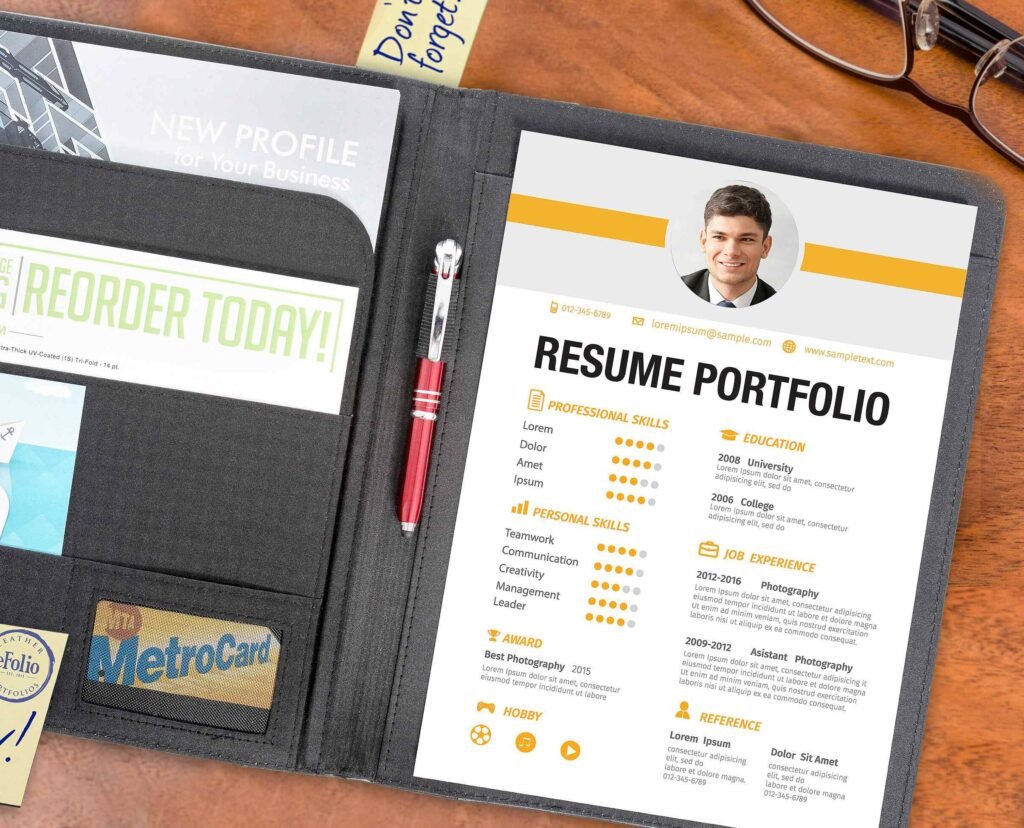
Preparation can help reduce uncertainty because you know the practical details are handled.
The night before, confirm:
- interview time;
- address or meeting link;
- route;
- interviewer name;
- resume copies;
- clothes;
- portfolio;
- questions;
- phone charge.
For an in-person interview, plan enough travel time to arrive near the location early.
Harvard recommends arriving around 10–15 minutes before the interview.
Indeed’s current guidance similarly suggests roughly 15 minutes early unless the employer gives different instructions.
Do not arrive at the reception desk 45 minutes early.
If you arrive very early, wait nearby and enter closer to the scheduled time.
🤖 Ready to Pivot from Paper to Person?
Don’t just guess **what to bring to an interview**. Use our AI Interview Kit Generatorto create a custom “Cheat Sheet” and land the job you deserve.
The Final Success Checklist: Before You Walk In
Use this checklist before leaving:
- [ ] Resume: Do I have enough copies for the expected interviewers plus extras?
- [ ] Pen: Do I have at least one working pen?
- [ ] Notebook: Do I have something to take short notes on?
- [ ] Questions: Have I prepared 3–5 useful questions?
- [ ] ID: Do I need identification for building access or employer verification?
- [ ] Portfolio: Do I have relevant work samples if the role calls for them?
- [ ] Job Description: Can I quickly review it before the meeting?
- [ ] Interview Details: Do I have the address, names, time, and contact information?
- [ ] Phone: Is it charged and switched to silent before the interview?
- [ ] Virtual Backup: If the interview is online, have I tested the link, microphone, camera, and connection?
- [ ] Arrival: Have I planned to arrive around 10–15 minutes early?
- [ ] Follow-Up: Do I know the interviewer’s name so I can send an appropriate thank-you message afterward?
Harvard recommends confirming the interview location or virtual meeting link, arriving 10–15 minutes early for in-person interviews, bringing extra resumes, and sending a thank-you email afterward.
Frequently Asked Questions
Do I really need hard copies of my resume in 2026?
For an in-person interview, bringing copies is still a sensible precaution.
The interviewer may already have your resume digitally, but extra copies can be useful if:
- another person joins;
- someone wants to take notes;
- the printed materials were not prepared.
Indeed still recommends bringing multiple resume copies to in-person interviews.
For a virtual interview, have the resume open or printed nearby instead.
How many resume copies should I bring?
A useful rule is:
one for each known interviewer + one or two extras
Indeed recommends multiple copies, including extras in case more interviewers participate.
Should I bring notes to an interview?
Yes, short notes can be appropriate.
Useful notes include:
- questions for the interviewer;
- a few accomplishment reminders;
- important facts about the role;
- interviewer names.
Indeed says notes can be appropriate when they contain questions or a few points you want to remember.
Avoid bringing complete scripted responses and reading from them throughout the interview.
Should I bring my laptop?
Only when it is useful.
Bring it if:
- you need it for a presentation;
- your portfolio is best viewed digitally;
- the employer asked you to bring one.
Otherwise, a laptop may simply be extra weight.
Should I bring references?
Usually not unless they are requested or you expect to reach that stage.
You can keep a reference sheet ready without handing it over automatically.
Should I bring my Social Security card?
Not to a normal interview unless the employer specifically requests documents for a legitimate employment-verification or onboarding process.
Do not carry sensitive identity documents unnecessarily.
What should I bring to a virtual interview?
Have nearby:
- your resume;
- job description;
- questions;
- brief notes;
- portfolio files;
- charger;
- water.
Also test your technology beforehand.
How early should I arrive?
About 10–15 minutes early is a reasonable target for many in-person interviews.
Harvard recommends this range, while Indeed currently recommends about 15 minutes unless the interviewer gives different instructions.
What should I not bring to an interview?
Avoid bringing unnecessary distractions such as:
- food you plan to eat during the interview;
- chewing gum;
- bulky personal belongings;
- confidential documents from previous employers;
- inappropriate work samples;
- an excessive number of papers;
- a ringing phone.
Your materials should support the interview, not distract from it.
Conclusion: From Paper to Professional Success
Knowing what to bring to an interview is mostly about simple preparation.
For a typical in-person interview, focus on:
- resume copies;
- pen and notebook;
- prepared questions;
- identification if needed;
- relevant work samples;
- interview details.
For virtual interviews, replace the physical folder with:
- accessible digital files;
- tested technology;
- the job description;
- your resume;
- prepared questions.
You do not need an expensive padfolio or elaborate “interview toolkit.”
You need to arrive prepared, organized, and ready to talk about your qualifications.
✨ Ready to Crush Your Next Interview?
Don’t let the “One Word” trap stop you. Log in to CVobjective to generate your personalized interview cheat sheet and land the job you deserve.
0 Comments