
Resume and Job Matching
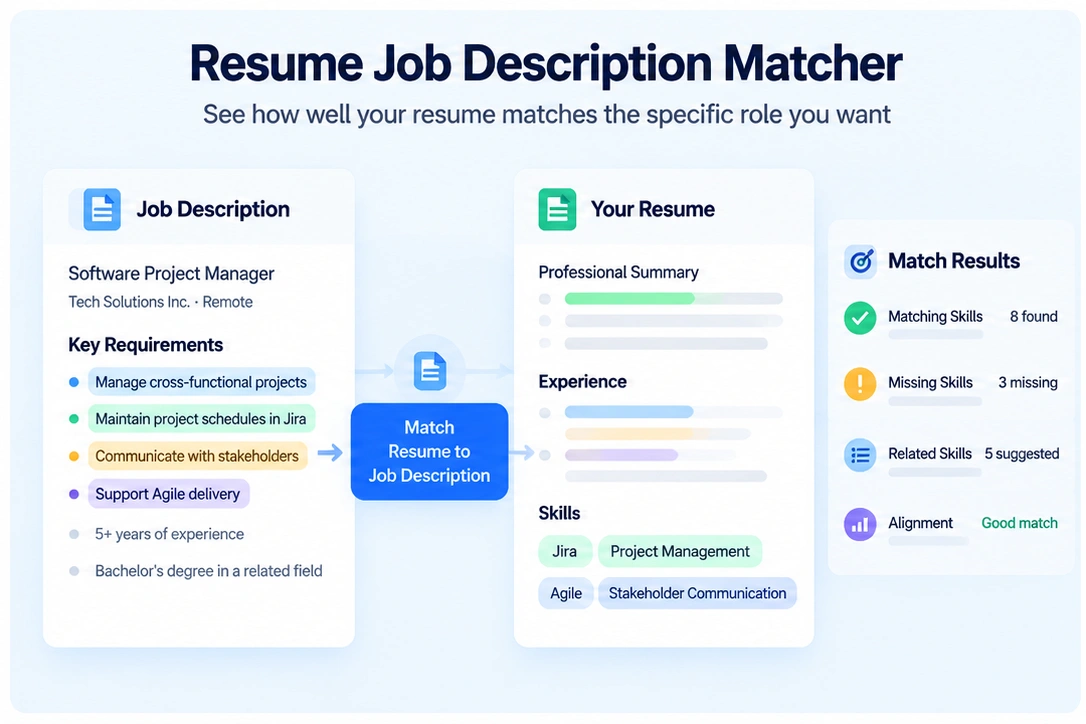
Resume Job Description Matcher
A resume job description matcher helps you compare your resume with the specific role you want—not just with generic resume advice.
By reviewing your skills, responsibilities, tools, certifications, and qualifications against a real job description, you can see where your experience aligns clearly and where important information may be missing or too vague.
The goal is not to rewrite your background to fit every requirement. The goal is to make your genuine qualifications easier to evaluate.
What Is a Resume Job Description Matcher?
A resume job description matcher compares the information in your resume with the requirements and responsibilities listed in a job posting.
A useful comparison may look at required and preferred skills, tools and technologies, certifications and licenses, job responsibilities, seniority, industry experience, role-specific terminology, and education requirements.
This gives you a more focused question than simply asking whether your resume is “good.”
How clearly does this resume support this particular application?
If you need additional information about the typical tasks, skills, knowledge, and technologies associated with an occupation, the O*NET OnLine occupational database provides occupation-specific reference information.
Required vs. Preferred Qualifications
One of the most important parts of matching a resume to a job description is understanding that not every requirement has the same meaning.
Required Qualifications
These usually describe capabilities or credentials the employer considers necessary for the role.
- Active RN license
- Three years of Java development experience
- CPA certification
- Experience with Salesforce
- Commercial driver's license
- Specific technical training
If you genuinely meet a required qualification, make it easy to identify on your resume.
Preferred Qualifications
Preferred qualifications may strengthen an application without necessarily being mandatory.
- AWS experience
- Bilingual communication
- Previous team leadership
- Industry-specific software
- Additional certifications
- Experience in a particular market
Do not pretend to meet a preferred qualification you do not have. Make your strongest relevant qualifications obvious instead.
Compare Your Resume With the Actual Job
Consider how the same genuine experience becomes easier to evaluate when the relationship to the target role is clear.
Job Description
Manage cross-functional projects, maintain project schedules in Jira, communicate with stakeholders, and support Agile software delivery.
Resume Before Revision
Helped different departments complete software projects.
Resume After Clarification
Coordinated Agile software projects in Jira, maintained delivery schedules, and communicated project requirements across engineering, product, and business stakeholders.
The revised version is stronger because it explains the experience more precisely. It does not invent a new qualification. It makes an existing qualification clearer.
What Should You Compare?
A useful resume-to-job comparison should focus on meaningful requirements rather than simply counting identical words.
Skills
Look for technical and professional skills the employer specifically requests, such as SQL, data analysis, project management, financial modeling, patient care, or account reconciliation.
Tools and Technologies
Systems such as Salesforce, Jira, Workday, Epic, AWS, Tableau, and Microsoft Excel should be easy to locate when you genuinely know them.
Responsibilities
Compare the job's work with your experience managing projects, supporting patients, preparing reports, maintaining inventory, supervising employees, or managing accounts.
Certifications and Licenses
Required credentials such as RN, CPA, PMP, BLS, EPA 608, or CDL should normally appear clearly in your resume.
Seniority
Review years of experience, scope of responsibility, leadership, decision-making, project size, and team size in the context of the target level.
Look Beyond Exact Keyword Matches
Matching does not mean every phrase must be identical.
Stakeholder Management
A resume might express this as: “Coordinated project requirements with clients and internal teams.”
Customer Relationship Management
A resume might express this as: “Maintained long-term client accounts and resolved service issues.”
A useful review considers meaning and evidence, not simply identical wording. This is also why a resume keyword checker can be useful as one part of a broader job-match review.
Which Resume Sections Matter Most?
Professional Summary
Establish profession, seniority, specialization, industry, and important qualifications.
Example: Financial analyst with five years of experience in forecasting, financial modeling, variance analysis, and executive reporting.
Skills
Use this section for genuine technical capabilities, tools, platforms, and credentials.
Example: Excel, SQL, Tableau, Financial Modeling, Forecasting.
Professional Experience
Replace vague labels with evidence. Explain the project, people involved, tools used, and result where supported.
Certifications and Education
Make required licenses easy to identify and follow the education requirements of the specific role instead of treating every job the same.
Missing Requirements Can Mean Different Things
A mismatch does not always mean the resume is weak. There are at least three possibilities.
The Experience Exists but the Wording Is Unclear
You may already have relevant experience but describe it differently. Clearer writing can make the connection easier to see.
The Experience Exists but Is Buried
An important qualification may appear deep inside a bullet instead of where recruiters can quickly identify it.
You Do Not Have the Qualification
If an employer requires an active CPA license and you do not hold one, rewriting the resume does not remove that gap. That is useful information too.
Do Not Rewrite Your Resume Around Skills You Do Not Have
Resume matching should make genuine qualifications clearer. It should never encourage you to invent software experience, certifications, licenses, responsibilities, leadership roles, metrics, or technical skills.
Do not copy an employer's wording if it creates a misleading impression about your experience. A truthful resume with a lower match is better than an inaccurate resume designed to maximize a score.
How to Match a Resume to a Job Description
Read the Full Job Description
Identify core responsibilities, required and preferred qualifications, tools, certifications, and experience requirements.
Review the Relevant Resume Sections
Check the summary, skills, experience, education, and certifications against those requirements.
Separate Genuine Gaps From Wording Gaps
Ask whether you lack the qualification or have simply described genuine experience differently.
Improve Relevant Sections
If the experience exists, make the relationship clearer without changing the facts.
Remove Irrelevant Emphasis
Use limited resume space for the experience that matters most to the current role.
Check the Revised Resume Again
Compare the updated version against the same target job before submitting it.
Resume Job Description Matcher vs. Generic Resume Review
Generic Resume Review
Asks whether the resume is readable, the sections are clear, the bullets are well written, and the format is consistent.
Job Description Match
Asks whether the resume clearly demonstrates the qualifications that matter for this particular job.
For a broader review of keyword coverage, skills alignment, and job-description fit, use the ATS Resume Checker.
Should You Use the Same Resume for Every Job?
Your employment history does not change from application to application, but the emphasis can.
A software engineer applying for a backend role may emphasize Python, APIs, databases, and AWS. The same candidate applying for a frontend role may emphasize JavaScript, React, accessibility, and UI performance.
Both versions can remain completely truthful. The difference is which relevant experience receives greater emphasis.
Build a Resume Around the Role You Want
Once you understand where the strongest matches and genuine gaps are, use those findings to improve your resume.
The Resume Builder can help you turn your skills, responsibilities, and accomplishments into a more focused draft for the role you want.
Frequently Asked Questions
What is a resume job description matcher?
It compares your resume with a target job posting to identify how clearly your skills, qualifications, responsibilities, tools, and experience align with the role.
How do I match my resume to a job description?
Start with the actual posting, identify required and preferred qualifications, compare them with your resume, and strengthen genuine relevant experience that is present but unclear.
Should I copy the job description into my resume?
No. Use the same terminology when it truthfully describes your experience, but do not copy responsibilities, qualifications, or skills you do not have.
Does every keyword need to match exactly?
No. Different wording can describe related experience. Context and evidence matter in addition to exact terminology.
What if I do not meet every job requirement?
A mismatch can reveal a genuine qualification gap. Do not invent qualifications; present the experience and skills you actually have as clearly as possible.
Is a job description matcher the same as an ATS checker?
Not exactly. Job-description matching focuses on alignment with one role. An ATS checker can provide a broader review of keywords, skills, resume sections, and revision priorities.