
Resume Keyword Checker
Resume Keyword Checker for Job Description Matching
Match your resume to the language employers actually use.
A resume keyword checker helps you compare your resume with a real job description, identify missing or underused skills, tools, certifications, qualifications, and role-specific terms, and see where your experience may not be clear enough.
The goal is not to copy every phrase from the job posting or stuff your resume with repeated keywords. The goal is to make genuine job-relevant experience easier to recognize.

What Is a Resume Keyword Checker?
A resume keyword checker compares the language in your resume with the terminology used in a target job description.
It can help identify whether important terms related to job titles, technical skills, tools and software, certifications, responsibilities, qualifications, and industry terminology are clearly represented in your resume.
Not every word in a job posting has equal importance. Focus primarily on terms that describe genuine requirements and responsibilities.
If you are unsure which tasks, skills, tools, or knowledge areas are commonly associated with a role, review occupation-specific information in the O*NET OnLine occupational database.
What Resume Keywords Should You Look For?
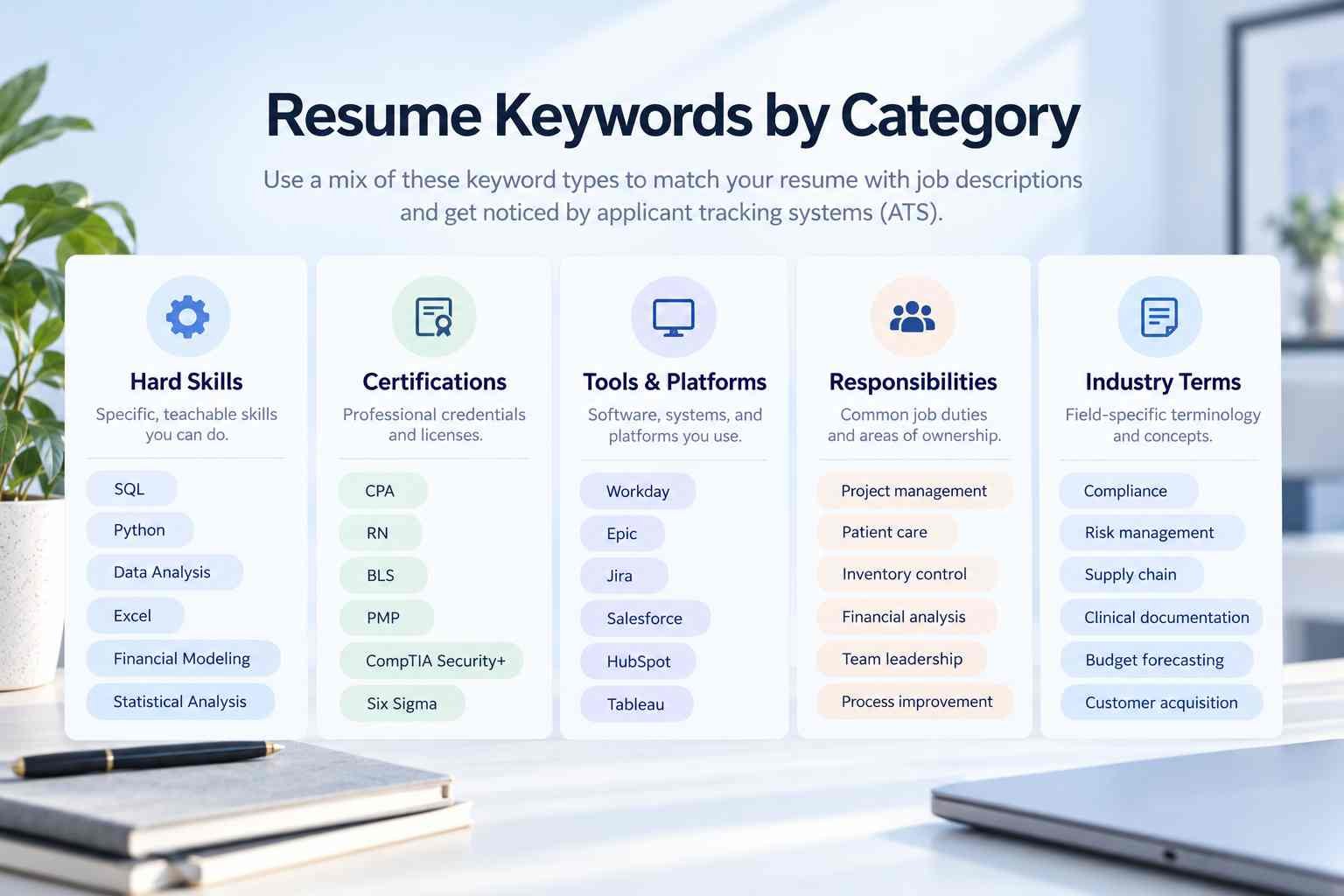
Hard Skills
These terms describe specific abilities or technologies.
- SQL, Python, and JavaScript
- Excel and financial modeling
- Salesforce, QuickBooks, and AutoCAD
Certifications and Licenses
Examples include CPA, RN, BLS, PMP, EPA 608, and CDL Class A. Only include credentials you genuinely hold.
Tools and Platforms
Look for named systems such as Workday, Epic, Jira, Salesforce, HubSpot, AWS, and Tableau.
Role-Specific Responsibilities
Examples include project management, patient care, inventory control, financial analysis, account reconciliation, and customer retention.
Industry Terminology
Different professions use different terminology. A healthcare resume may use very different language from a software engineering, finance, logistics, or administrative resume.
Check Your Resume Against a Real Job Description
Generic resume advice can only go so far. A stronger approach is to compare your resume with the specific role you want.
Your Resume
Managed customer accounts, resolved service issues, and supported daily branch operations.
Job Description
Manage client relationships, identify financial needs, recommend banking products, and maintain regulatory compliance.
Missing Keywords Do Not Automatically Mean You Have a Bad Resume
A keyword gap can mean the resume simply uses different wording.
Job Description
Customer relationship management
Resume
Maintained long-term client accounts
Those phrases may describe related experience even though the wording differs. A missing term can also reveal a genuine qualification gap, so use keyword checking as a review tool rather than a reason to blindly copy terminology.
Resume Keyword Matching Is More Than Counting Words
Repeating a term does not demonstrate ability.
Weak Example
Project management, project management, project management.
Stronger Example
Coordinated a six-month software implementation project across engineering, sales, and customer-success teams.
Keywords work best when supported by genuine experience, responsibilities, qualifications, or measurable results.
Avoid Resume Keyword Stuffing
Keyword stuffing means inserting large numbers of job-description terms without meaningful context. It can make a resume repetitive, difficult to read, and less credible.
Place relevant terms naturally in:
- Professional Summary
- Skills
- Experience
- Education
- Certifications
Where Should Resume Keywords Appear?
Professional Summary
Financial analyst with 5 years of experience in forecasting, financial modeling, variance analysis, and Excel-based reporting.
Skills
Excel, SQL, Tableau, Financial Modeling, and Forecasting.
Experience
Instead of listing only "Inventory management," explain the evidence: "Managed inventory levels across three warehouse locations and reduced stock discrepancies by 18%."
Education and Certifications
Make required degrees, licenses, and certifications easy to find, but only include qualifications you actually hold.
Resume Keyword Checker vs. ATS Resume Checker
A keyword checker focuses mainly on whether important job-related terminology appears clearly in your resume.
An ATS Resume Checker provides a broader review of the relationship between the resume and target job, including keyword coverage, skills alignment, job-description matching, weak sections, and revision priorities.
Build a Resume Around the Job You Want
Finding missing keywords is only the first step. Once the gaps are clear, update the sections that matter most with Resume Builder.